An Evening of Mozart in the Heart of Vienna.
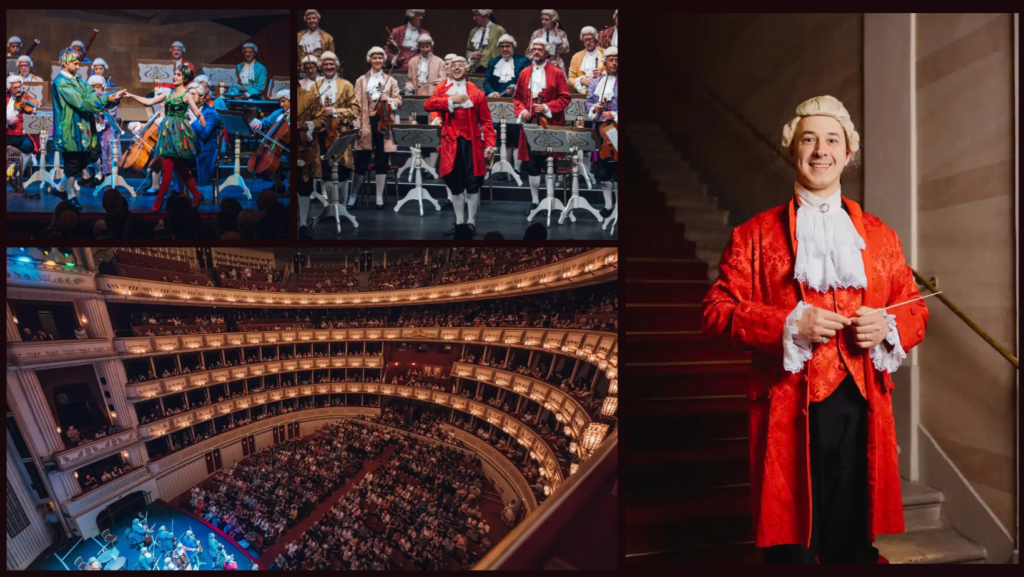
August 24, 2026, was one of those evenings when music and place seemed to come together in an almost natural way. At the Wiener Staatsoper, one of the great historic temples of European music, the audience had the opportunity to attend a concert by the Wiener Mozart Orchester, conducted by the Brazilian maestro Vinicius Kattah.
The choice of Mozart was, in itself, enough to create a particular sense of anticipation. His music does not need grand gestures to communicate with an audience; it requires above all clarity, subtlety, rhythmic precision, and a finely judged sense of balance. That balance between transparency and expressiveness is precisely one of the great challenges of performing Mozart.
The presence of Vinicius Kattah gave the evening a lively and direct dimension. His conducting presented Mozart not as a distant, “museum-like” figure from the past, but as a composer of immediacy, theatricality, and powerful communicative energy. Particularly important in a Mozart programme is the sense of dialogue: between the instruments, between the stage and the auditorium, and above all between the musicians and the audience.
Perhaps this is also the greatest strength of an evening such as this the opportunity to experience Viennese musical tradition not as something distant or purely academic, but as a living experience. The Wiener Staatsoper itself becomes part of that experience. Its architecture, history, and deep connection with opera create a setting in which Mozart’s music acquires an additional symbolic dimension.
The Wiener Mozart Orchester, after all, is closely associated with presenting Mozart within the musical tradition of Vienna. In performances during 2026, its programmes have included characteristic works from Don Giovanni, as well as Mozart’s orchestral repertoire, including the Clarinet Concerto in A major, K. 622.
The overall impression is one of a performance that brings together tradition, elegance, and immediacy. Mozart’s music remains remarkably capable of creating a direct connection between performers and listeners, even more than two centuries after the composer’s death.
Ultimately, what remains from an evening such as this is not simply the precision of the performance. It is, above all, the feeling that Mozart continues to create a living dialogue between the stage and the audience.
And perhaps that is the most distinctive impression of a Mozart evening in Vienna tradition is not merely presented — it is experienced.